Instructional Strategies for Managing Cognitive Load in Science Learning: A Systematic Literature Review
DOI:
https://doi.org/10.47945/search.v5i1.3276Keywords:
Cognitive Load, Cognitive Load Theory, Instructional Strategies, Science Learning, Systematic Literature ReviewAbstract
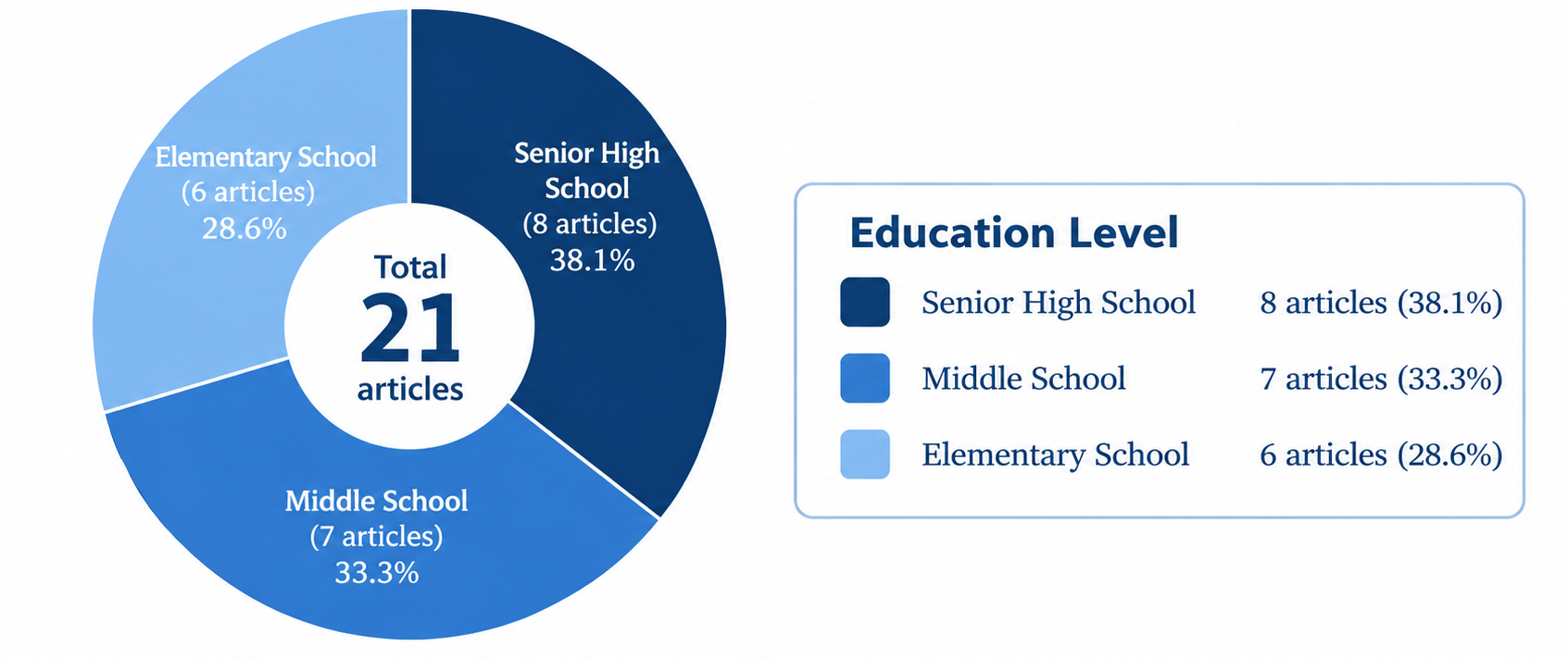
This study aims to identify and analyze instructional strategies for managing students' cognitive load in science learning within the Cognitive Load Theory (CLT) framework. A systematic literature review was conducted following PRISMA 2020 guidelines, searching the Google Scholar and Scopus databases via Publish or Perish software, with the last search conducted on June 12, 2026, covering publications from 2016 to 2026. Included articles were empirical studies in peer-reviewed journals indexed in Scopus, Sinta, DOAJ, or equivalent local peer-reviewed outlets, focusing on the application of instructional strategies to manage cognitive load among primary and secondary school students. A total of 21 articles were selected from an initial pool of 95, through a four-stage screening process involving deduplication, title and abstract screening, and full-text eligibility assessment. Data were synthesized through descriptive, content, and critical analysis to identify trends across studies. The analysis focused on the types of instructional strategies employed and their implications for managing intrinsic cognitive load (ICL), extraneous cognitive load (ECL), and germane cognitive load (GCL). The findings revealed three main trends. First, technology and digital media were widely adopted to reduce ECL by presenting information in a more structured, multimodal format. Second, active learning models, such as problem-based learning and generative approaches, enhanced GCL by fostering deeper cognitive engagement. Third, instructional designs that explicitly integrate CLT principles, such as chunking, pacing, and the 4C/ID model, demonstrated the most comprehensive potential for managing students' cognitive load. These findings affirm the importance of instructional design aligned with students' working memory capacity to enhance the effectiveness of science learning. However, the absence of a formal risk-of-bias assessment represents a methodological limitation that should be considered when interpreting these findings.
References
Agbidye, A., Achor, E. E., & Ogbeba, J. (2019). Problem-based learning strategy in upper basic two and science students’ cognitive load in Makurdi, Nigeria. International Centre for Science, Humanities and Education Research Journal (ICSHERJ), 4(2), 92–99. https://papers.ssrn.com/sol3/papers.cfm?abstract_id=3453693
Angga, N. M., Phieranto, C. C., Teio, F., Yovan, D., Angelica, A., & Putri, F. S. (2022). Chunk learning media for cognitive load optimization on science learning. In 2022 Seventh International Conference on Informatics and Computing (ICIC) (pp. 1-6). IEEE. https://ieeexplore.ieee.org/abstract/document/10006912/
Chen, C. H., Chan, W. P., Huang, K., & Liao, C. W. (2023). Supporting informal science learning with metacognitive scaffolding and augmented reality: Effects on science knowledge, intrinsic motivation, and cognitive load. Research in Science & Technological Education, 41(4), 1480-1495. https://doi.org/10.1080/02635143.2022.2032629
Chen, C. H., & Chang, C. L. (2024). Effectiveness of AI-assisted game-based learning on science learning outcomes, intrinsic motivation, cognitive load, and learning behavior. Education and Information Technologies. https://doi.org/10.1007/s10639-024-12553-x
Donthu, N., Kumar, S., Mukherjee, D., Pandey, N., & Lim, W. M. (2021). How to conduct a bibliometric analysis: An overview and guidelines. Journal of Business Research, 133, 285–296. https://doi.org/10.1016/j.jbusres.2021.04.070
Du, L., Tang, X., & Wang, J. (2025). Different types of textual cues in educational animations: Effect on science learning outcomes, cognitive load, and self-efficacy among elementary students. Education and Information Technologies, 30(3), 3573–3596. https://doi.org/10.1007/s10639-024-12929-z
Fadl, N., & Youssef, W. (2020). Science learning in augmented reality context: An exploration of learners’ cognitive load and attitudes. International Journal of Instructional Technology and Educational Studies, 1(2), 10–14. https://ijites.journals.ekb.eg/article_86658.html
Hong, J. C., Hwang, M. Y., Tai, K. H., & Tsai, C. R. (2017). An exploration of students’ science learning interest related to their cognitive anxiety, cognitive load, self-confidence and learning progress using inquiry-based learning with an iPad. Research in Science Education, 47(6), 1193-1212. https://doi.org/10.1007/s11165-016-9541-y
Hsieh, Ho, S.-C., Wu, M., & Ni, C.-Y. (2016). The effects of concept map-oriented gesture-based teaching system on learners’ learning performance and cognitive load in earth science course. Eurasia Journal of Mathematics, Science and Technology Education, 12(3), 621–635. https://doi.org/10.12973/eurasia.2016.1235a
Kpiranyam, F. S., Enemarie, V., & Fakaa, S. G. (2024). Effect of experiential learning strategy on secondary students’self-efficacy and cognitive load in difficult biology concepts in benue state. Fuoye International Journal of Education, 7(1), 1-15. https://fjed.fuoye.edu.ng/index.php/public_html/article/view/104
Kraus, S., Bouncken, R. B., & Yela Aránega, A. (2024). The burgeoning role of literature review articles in management research: An introduction and outlook. Review of Managerial Science, 18(2), 299–314. https://doi.org/10.1007/s11846-024-00729-1
Krieglstein, F., Beege, M., Rey, G. D., Sanchez-Stockhammer, C., & Schneider, S. (2023). Development and validation of a theory-based questionnaire to measure different types of cognitive load. Educational Psychology Review, 35(9), 1-37. https://doi.org/10.1007/s10648-023-09738-0
Lai, A. F., Chen, C. H., & Lee, G. Y. (2019). An augmented reality‐based learning approach to enhancing students’ science reading performances from the perspective of the cognitive load theory. British Journal of Educational Technology, 50(1), 232-247. https://doi.org/10.1111/bjet.12716
Li, N., Zhang, X., & Limniou, M. (2023). A country’s national culture affects virtual learning environment adoption in higher education: A systematic review (2001–2020). Interactive Learning Environments, 31(7), 4407–4425. https://doi.org/10.1080/10494820.2021.1967408
Mishra, D. (2025). Technology Driven Language Learning: Innovations and Applications. Palgrave Macmillan. https://link.springer.com/chapter/10.1007/978-3-031-77232-0_2
Moshizi, N. N. F., Towhidi, A., & Tajrobehkar, M. (2020). The effect of virtual instruction using the model of van merriënboer’s four-component instructional design in science using multimedia method on cognitive load, learning, and academic motivation of the sixth-grade students of primary schools. New Educational Approaches, 15(1), 157-176. https://nea.ui.ac.ir/article_25550_en.html
Mutanaffisah, R., Ningrum, R., & Widodo, A. (2021). Ketepatan pemilihan pendekatan, metode, dan media terhadap karakteristik materi IPA. Jurnal Inovasi Pendidikan IPA, 7(1), 12–21. https://doi.org/10.21831/jipi.v7i1.32622
Nugraha, W. S. (2021). The use of talking toys in reducing the cognitive loads of elementary school students in science learning. Journal of Physics Conference Series, 1987(1). https://doi.org/10.1088/1742-6596/1987/1/012048
Nugroho, I. R., Wilujeng, I., & Prasetyo, Z. K. (2023). Mobile learning research trends in indonesia: A systematic literature review. Jurnal Penelitian Pendidikan IPA, 9(8), 356–365. https://doi.org/10.29303/jppipa.v9i8.3073
Nurwanda, Y., Milama, B., & Yunita, L. (2020). Beban kognitif siswa pada pembelajaran kimia di pondok pesantren. Jurnal Inovasi Pendidikan Kimia, 14(2), 2629-2641. https://journal.unnes.ac.id/nju/JIPK/article/view/21813
Oh, S., & Kim, Y. (2016). The effects of generative concept map on science learning achievement and cognitive load. Educational Technology International. https://koreascience.kr/article/JAKO201612359817222.page
Pramudiyan, H., & Fadhilah, M. (2024). Hubungan minat belajar dan beban kognitif siswa pada pembelajaran klasifikasi makhluk hidup di SMAN 1 Sawahlunto. Jurnal Pendidikan Tambusai, 8, 3815-3826.
Putri, A. G. P., Herawati, M. A., Karim, N. I., & Ramadhani, D. A. (2025). Strategi pembelajaran IPA berbasis konkret untuk mengatasi kesulitan berpikir abstrak pada siswa SD dalam memahami konsep ilmiah. Algoritma: Jurnal Matematika, Ilmu Pengetahuan Alam, Kebumian Dan Angkasa, 3(4), 255–266. https://doi.org/10.62383/algoritma.v3i4.680
Putri, M. D., Rahmat, A., & Sanjaya, Y. (2021). Penerapan teknik chunking untuk mengendalikan beban kognitif intrinsik siswa sma pada pembelajaran sistem reproduksi manusia. In Proceeding Biology Education Conference: Biology, Science, Enviromental, and Learning (Vol. 18, No. 1, pp. 25-29). https://jurnal.uns.ac.id/prosbi/article/view/58054
Reski, S. H., & Fadilah, M. (2024). Analisis media pembelajaran terhadap beban kognitif peserta didik pada pembelajaran biologi. Jurnal Bioshell, 13(1), 11-16. https://ejurnal.uij.ac.id/index.php/BIO/article/view/2773
Sabilla, Z., Ridwan, A., & Yusmaniar, Y. (2019). Hubungan antara pemahaman konsep dengan beban kognitif siswa pada materi hidrolisis garam. Jurnal Riset Pendidikan Kimia (JRPK), 9(1), 46–51. https://doi.org/10.21009/JRPK.091.06
Santoso, E. A. (2023). Penerapan metode pacing dan dual processing untuk mencegah beban kognitif berlebih siswa dalam pembelajaran fisika. INKUIRI: Jurnal Pendidikan IPA, 12(3), 192-200. https://jurnal.uns.ac.id/inkuiri/article/view/79319
Sarkis-Onofre, R., Catalá-López, F., Aromataris, E., & Lockwood, C. (2021). How to properly use the PRISMA statement. Systematic Reviews, 10(1), 117. https://doi.org/10.1186/s13643-021-01671-z
Shermeh, M. R., & Hashemi, S. (2020). Comparing the effect of cognitive load theory, multimedia and speech teaching methods on learning students’ in science courses. Research in School and Virtual Learning, 8(2), 93–103. https://doi.org/10.30473/etl.2020.54246.3283
Shi, Y., Cao, C., Chen, H., Qu, Z., Duan, J., & Yang, H. H. (2024). Study on the influencing factors of junior high school students’ cognitive load in the smart classroom environment. 2024 International Symposium on Educational Technology (ISET), 347–351. https://doi.org/10.1109/ISET61814.2024.00075
Syagif, A. (2024). Teori beban kognitif john sweller dan implikasinya dalam pembelajaran bahasa arab pada jenjang pendidikan dasar. Fashluna, 5(2), 93-105. http://www.ejournal.stitbima.ac.id/index.php/fashluna/article/view/883
Tazesh, M., & Kadivar, P. (2016). Role of seductive details in multimedia learning of science: effects on cognitive load and performance. Journal of Cognitive Psychology, 4(3). https://jcp.khu.ac.ir/browse.php?a_id=2555&sid=1&slc_lang=ar&ftxt=1
Utomo, D. P., Holisin, I., Inganah, S., & Hidayati, W. S. (2025). Monograf-efisiensi kognitif dalam pembelajaran matematika: Integrasi strategi pengajaran, persepsi mahasiswa, dan teori beban kognitif di pendidikan tinggi. UMMPress. https://books.google.com/books?hl=en&lr=&id=j4uREQAAQBAJ&oi=fnd&pg=PA123&dq=beban+kognitif+pembelajaran&ots=y8gNH7hloS&sig=fWAw92CIkTDruvTWJamyw8rdND0
Weng, C., Otanga, S., Weng, A., & Cox, J. (2018). Effects of interactivity in e-textbooks on 7th graders science learning and cognitive load. Computers & Education, 120(2), 172-184. https://www.sciencedirect.com/science/article/pii/S0360131518300411
Yilmaz, R. M. (2023). Effects of using cueing in instructional animations on learning and cognitive load level of elementary students in science education. Interactive Learning Environments, 31(3), 1727-1741. https://doi.org/10.1080/10494820.2020.1857784